Head
Agata Adamczyk, Prof., Ph.D. phone: +48 22 60 86 572, This email address is being protected from spambots. You need JavaScript enabled to view it.
Secretariat
Dorota Rycko, phone: +48 22 60 86 413, This email address is being protected from spambots. You need JavaScript enabled to view it.
Research staff
Grzegorz A. Czapski, Assoc. Prof., Ph.D., phone: +48 22 60 86 613, This email address is being protected from spambots. You need JavaScript enabled to view it.
Magdalena Gąssowska-Dobrowolska, Assoc. Prof., Ph.D., phone: +48 22 60 86 420, This email address is being protected from spambots. You need JavaScript enabled to view it.
Anna Wilkaniec, Ph.D., phone: +48 22 60 86 600, This email address is being protected from spambots. You need JavaScript enabled to view it.
Magdalena Cieślik, Ph.D., phone: +48 22 60 86 420, This email address is being protected from spambots. You need JavaScript enabled to view it.
Gabriela Olech-Kochańczyk, Ph.D., phone: +48 22 60 86 420, This email address is being protected from spambots. You need JavaScript enabled to view it.
Ewelina Pałasz, Ph.D., phone: +48 22 60 86 414, This email address is being protected from spambots. You need JavaScript enabled to view it.
Piotr Wójcik, Ph.D., phone: +48 22 60 86 414, This email address is being protected from spambots. You need JavaScript enabled to view it.
Ewelina Bielska, M.Sc. Eng., phone: +48 22 60 86 413, This email address is being protected from spambots. You need JavaScript enabled to view it.
Emeritus Professors:
Prof. Joanna B. Strosznajder, PhD, DSc - professor emeritus; scientific collaborator This email address is being protected from spambots. You need JavaScript enabled to view it.
Technical staff
Elżbieta Gawinek, M.Sc. phone: +48 22 60 86 413, This email address is being protected from spambots. You need JavaScript enabled to view it.
PhD students
Agnieszka Banaszek, M.Sc. Ing., phone +48 22 60 86 600, This email address is being protected from spambots. You need JavaScript enabled to view it.
Research profile
Our research focuses on the molecular and cellular mechanisms that determine brain vulnerability to neurodegenerative and neurodevelopmental disorders. We are particularly interested in the interplay between metabolic and redox homeostasis, proteostasis, mitochondrial quality control, and neuroimmune responses, which represent key determinants of brain dysfunction.
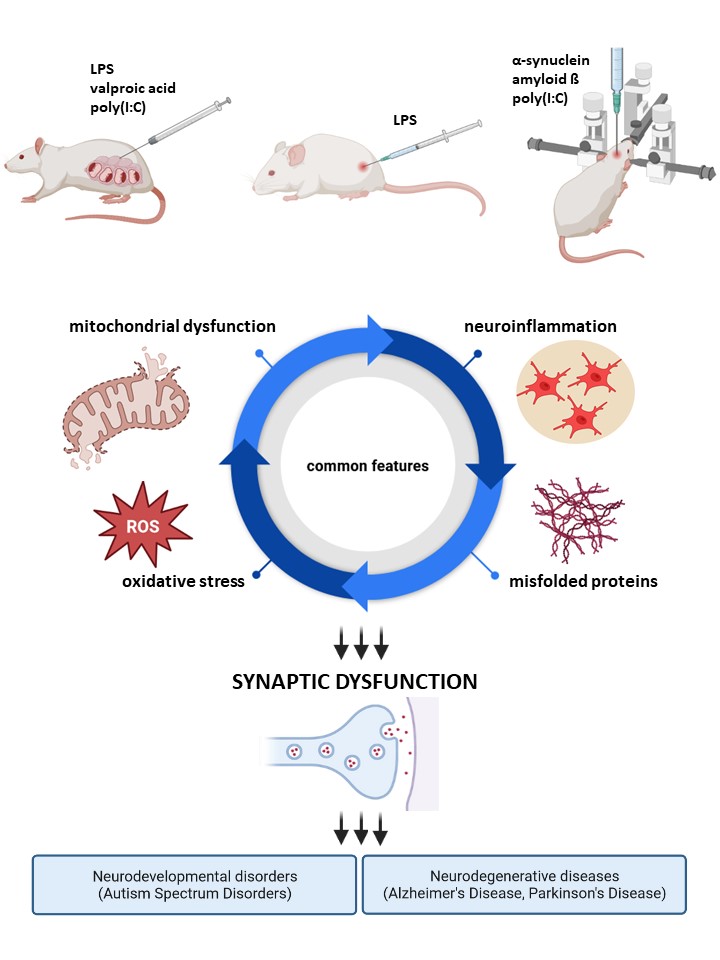
Our research addresses the role of PRKN/Parkin in cellular metabolism, redox homeostasis, and mitochondrial quality control; purinergic signaling, including P2X7 receptor-mediated mechanisms; and processes associated with the pathological accumulation and propagation of proteins such as α-Synuclein, Amyloid-β, and Tau. We investigate the mechanistic interplay between mitochondrial dysfunction, metabolic and redox disturbances, protein aggregation, and neuroimmune responses, and how their convergence may initiate and drive pathological processes in the brain.
We integrate molecular and cellular studies with analyses of neuronal function and organismal phenotypes, using cell-based and organotypic in vitro models as well as genetic and environmentally induced animal models. This multilevel approach enables us to connect molecular mechanisms with cellular function and systems-level organization of the nervous system, spanning molecules and organelles, neurons and synapses, neuronal circuits, and behavior.
Our overarching goal is to identify the mechanisms that initiate and sustain brain dysfunction, define their interrelationships, and identify novel molecular and cellular targets for therapeutic intervention in disorders of the central nervous system.
Grants
The mechanisms of mitochondrial damage-dependent neuroinflammation in experimental models of Parkinson’s disease. The role of Parkin dysfunction. NCN, OPUS 20 LAP, 2020/39/I/NZ4/01031, 2021-2025; Project manager – Prof. Agata Adamczyk, Ph.D.;
The impact of exercise on the level of the CDNF / MANF family neurotrophic factors in a murine model of Parkinson's disease induced by intracerebral administration of alpha-synuclein oligomers. NCN, MINIATURA 4, 2020/04/X/NZ4/00773, 2022-2023; Project manager - Ewelina Pałasz, PhD;
The role of ATP-dependent activation of P2 purinergic receptors in the energetic disturbances in the brain of autistic-like animals. NCN, Preludium 20, 2021/41/N/NZ4/02350, 2022-2025; Project manager - Lidia Babiec, M.Sc. Ing;
Novel role of peroxisome proliferator-activated receptor α in the regulation of amyloid β peptide metabolism and mitochondrial function in an animal model of Alzheimer’s disease. NCN Preludium 2019/35/N/NZ4/03706, 2020-2023; Project manager - Sylwia Wójtowicz, Ph.D.;
The role of BET family proteins in microglia-dependent neurodegeneration; relevance to Alzheimer's disease. NCN OPUS 2018/31/B/NZ4/01379, 2019-2023; Project manager – Grzegorz A. Czapski, Assoc. Prof., Ph.D.;
The influence of impairment of extracellular nucleoside and nucleotide signaling on synaptic structure and function in autism. NCN OPUS 2017/25/B/NZ4/01969, 2018-2022; Project manager – Prof. Agata Adamczyk, Ph.D.;
The role of maternal immune activation on mitochondria function. Implication for neurodevelopmental disorders. NCN SONATA 2016/23/D/NZ4/03572, 2017-2021; Project manager - Magdalena Cieślik, Ph.D.;
Molecular mechanisms involved of the gut-brain interaction in autism spectrum disorders. Potential role of probiotics in the treatment of autism. SymbioPharm GmbH, Germany; 2018-2019; Project manager – Agata Adamczyk, Assoc. Prof., Ph.D.;
Significance of sphingosine kinase-1 and sphingosine-1-phosphate in the experimental model of Parkinson's disease and pharmacological neuroprotection. NCN, Etiuda 4, 2016/20/T/NZ3/00504, 2016-2017; Project manager – Joanna A. Motyl, Ph.D.;
The role of Sphingosine -1-phosphate (S1P) receptors signaling in animal model of Parkinson’s disease. Searching of novel therapeutic targets. NCN, 2013/09/N/NZ4/02045, 2014-2016; Project manager - Joanna A. Pyszko, M.Sc.;
The role of poly(ADP-ribose) polymerase and sirtuins in molecular mechanism of cell death. Identification of novel targets for Alzheimer's therapy. NCN, OPUS, 2013/09//B/NZ3/01350, 2014-2017; Project manager – Prof. Joanna B. Strosznajder, Ph.D.;
The involvement of P2 purinergic receptors in alpha-synuclein mediated mitochondrial dysfunction. Relevance to Parkinson’s disease. NCN, 2013/009/D/NZ3/01359, 2014-2016; Project manager - Anna Wilkaniec, Ph.D.;
The role of Parkin in exogenous Alpha-synuclein-induced cell death. Implications for pathogenesis of Parkinson’s disease and other synucleinopathies. NCN, 2012/05/B/NZ3/02047, 2012-2016; Project manager – Agata Adamczyk, Assoc. Prof., Ph.D.;
Collaboration
- Medical University of Warsaw, Faculty of Pharmacy, Department of Pharmacodynamics, Warsaw, Poland - Prof. Magdalena Bujalska-Zadrożny;
- Nencki Institute of Experimental Biology PAS, Laboratory of Behavioral Methods, Warsaw, Poland - Paweł Boguszewski, Ph.D.;
- Nencki Institute of Experimental Biology PAS, Department of Biochemistry, Warsaw, Poland - Krzysztof Nieznański, Ph.D.;
- Pomeranian Medical University, Department of Biochemistry and Medical Chemistry, Szczecin, Poland - Prof. Irena Baranowska-Bosiacka;
- Central Clinical Hospital of the Ministry of Interior and Administration in Warsaw, Poland - Kamila Bojakowska, M.D.;
- Faculty of Chemistry, University of Warsaw, Poland - Marcin Strawski, Ph.D.;
- Medical University of Białystok, Poland - Prof. Barbara Mroczko;
- Institute of Pharmacology and Clinical Pharmacy, Biochemical and Pharmacological Center, Marburg, Germany - Prof. Carsten Culmsee;
- Louisiana State University Health Sciences Center, Department of Neurology, New Orleans, LA, USA - Prof. Walter J. Lukiw;
- University of Missouri, Thompson Center For Autism & Neurodevelopmental Disorders, Columbia , MO, USA - Prof. David Q. Beversdorf;
- University of Missouri, Department of Biochemistry, Columbia, MO, USA – Prof. Grace Y. Sun;
- Institute for Pharmacy and Biochemistry, Pharmacology and Toxicology, Johannes-Gutenberg University Mainz, Mainz, Germany - Prof. Kristina Friedland;
Research equipment
- Flow cytometer Becton Dickinson FACS Canto II;
- Microplate reader Thermo Scientific Multiscan GO;
- Spectrophotometer Nanodrop 2000;
- Spectrophotometer Shimadzu UV-1700;
- Thermocycler Perkin–Elmer GeneAmp PCR System 2400;
- Thermocycler Eppendorf Mastercycler;
- Inverted fluorescent microscope OLYMPUS IX-71;
- Scintillation counter Wallac 1409;
- Ultracentrifuge Backman LE-70;
- Stereotaxic instrument for small animals RWD Life Science;
- SomnoSuite Low-Flow Anesthesia System Kent Scientific;
Research methods
- Behavioral studies: analysis of mouse and rat behavior using behavioral tests, including the open field test, novel object recognition test, social novelty test (Crawley’s test), social isolation test, elevated plus maze, rotarod performance test, grip strength test, and pole test; assessment of sickness behavior in mice using the Murine Sepsis Score (MSS) scale.
- Cell culture and work with biological material: culture of mammalian cells and bacteria in vitro, cell transfection by electroporation and lipofection, gene silencing in vitro using siRNA, and bacterial transformation using the Ca²⁺ method.
- Analysis of cell viability and cell death: assessment of cell viability and death using MTT, LDH, trypan blue exclusion and propidium iodide staining, as well as analysis of apoptosis-related chromatin condensation using Hoechst 33342.
- Analysis of cell morphology and function: morphometric analysis of neurites in vitro, analysis of cell migration using the scratch assay, and analysis of phagocytosis using fluorescent microspheres.
- Oxidative stress and cellular metabolism: analysis of oxidative stress in vitro using fluorogenic probes DCF, DAF-2 and MitoSOX, assessment of mitochondrial membrane potential using the JC-1 assay, analysis of ATP levels by bioluminescence, and analysis of glutathione levels and redox state-related enzyme activity using spectrophotometric methods.
- Oxidative modifications of biomolecules: analysis of lipid peroxidation and protein oxidation using spectrophotometric methods (TBARS, DNPH) and screening of total antioxidant activity using the DPPH assay.
- Calcium homeostasis and enzyme activity: analysis of calcium influx into cells in vitro using radioisotope methods or the fluorogenic probe FLUO-4, and analysis of enzyme activity using radioisotope, spectrophotometric and fluorescence-based methods.
- Protein analysis: analysis of protein immunoreactivity by Western blot, ELISA, LUMINEX and antibody array, as well as analysis of post-translational protein modifications by immunoprecipitation followed by Western blotting, including ubiquitylation, phosphorylation, S-nitrosylation and poly(ADP-ribosyl)ation; analysis of cytoskeleton stability by electrophoresis and immunoblotting of α/β-tubulin.
- Nucleic acid and gene expression analysis: isolation of DNA, RNA and miRNA; analysis of mRNA and miRNA levels by RT-PCR, qPCR and gene expression arrays; and analysis of gene polymorphisms by PCR and RFLP.
- Genetic manipulation: CRISPR/Cas9-mediated genome editing and gene silencing in vitro using siRNA.
- Cellular and tissue analysis: immunohistochemistry, flow cytometry, and fluorescence and confocal microscopy of cells and tissues.
- Endotoxin analysis: analysis of endotoxin presence using the rFC (recombinant factor C) assay.
Experimental models in vitro:
- primary cultures of rodent neurons, microglia, and macrophages;
- co-culture of various cell types in a Transwell system;
- cell line SH-SY5Y – neuron-like cells derived from human neuroblastoma;
- cell line C20 - immortalized human microglia;
- cell line LUHMES - Lund human mesencephalic cells;
- cell line PC12 – neuron-like cells derived from rat adrenal gland pheochromocytoma;
- cell line HT22 – immortalized mouse hippocampal neurons;
- cell line BV2 – immortalized mouse microglia;
- cell line RAW 264.7 – immortalized mouse macrophages;
- transfected cell line PC12 stably expressing human wild-type APP gene;
- transfected cell line PC12 stably expressing human APP gene with double Swedish mutation (K670M/N671L);
- transfected cell line PC12 stably expressing human wild-type SNCA gene;
- transfected cell line PC12 stably expressing human wild-type PRKN gene;
Experimental models in vivo:
- murine model of Alzheimer’s disease – intracerebroventricular administration of oligomeric Aβ;
- murine model of Parkinson’s disease – intrastriatal administration of α-synuclein;
- animal models of systemic inflammation – intraperitoneal administration of lipopolysacharide (LPS) to rats and mice;
- rat model of autism in offspring – prenatal exposition to valproic acid (VPA) – intraperitoneal administration of VPA at 12.5 day of pregnancy;
- rat model of neurodevelopmental diseases in offspring – prenatal exposition to maternal immune activation (MIA) – intraperitoneal administration of LPS at 9.5 day of pregnancy;
- murine model of neurodevelopmental diseases in offspring – prenatal exposition to maternal immune activation (MIA) – intraperitoneal administration of poly(I:C) at 17 day of pregnancy;
- Parkin knock-out mice (homozygous), B6.129S4-Prkntm1Shn/J mice on a C57BL/6 background;
- Parkin overexpressing mice - strain B6; FVB-Tg(Prnp-PARK2)196Kfw/EkraJ;
- P2X7 knockout mice (B6.129P2-P2rx7^tm1Gab/J)
Selected publications
- Matuszewska, M., Cieślik, M., Sulejczak, D., Wilkaniec, A., & Czapski, G. A. (2026). BET protein inhibitor JQ1 reduces inflammation and hippocampal amyloid-β level without altering Tau phosphorylation in LPS-challenged adult wild-type mice. Brain Research, 1884, 150318. https://doi.org/10.1016/j.brainres.2026.150318
- Wilkaniec, A., Czapski, G. A., Cieślik, M., Olech-Kochańczyk, G., Gawinek, E., Bielska, E., Ruiz-Ortega, E. D., Babiec, L., Strawski, M., Wójcik, P., Culmsee, C., & Adamczyk, A. (2026). Soluble α-synuclein oligomers drive transient corticostriatal pathology and delayed nigral vulnerability in a mouse model of early α-synucleinopathy. Acta Neuropathologica Communications, 14(1), 168. https://doi.org/10.1186/s40478-026-02340-9
- Wójcik, P., Culmsee, C., & Adamczyk, A. (2026). Toxic Alpha-Synuclein and the Opening of the Gate: Blood–Brain Barrier Damage and Stepwise Leukocyte Infiltration. Cellular and Molecular Neurobiology, 46(1), 100. https://doi.org/10.1007/s10571-026-01733-7
- Ruiz-Ortega, E. D., Wilkaniec, A., Juárez, J., & Adamczyk, A. (2025). Cardiolipin and mitochondrial membrane integrity in neurodegeneration: Insights from α-synuclein-driven Parkinson’s disease. Acta Neuropathologica Communications, 14(1), 11. https://doi.org/10.1186/s40478-025-02190-x
- Bielska, E., Matuszewska, M., Wójcik, P., Wilkaniec, A., Cieślik, M., Gąssowska-Dobrowolska, M., Sulejczak, D., Czapski, G. A., & Adamczyk, A. (2025). Tau Hypophosphorylation at Ser416 as the Early Molecular Imprint of Maternal Immune Activation: Insights from Female Mice Offspring. International Journal of Molecular Sciences, 26(21), 10778. https://doi.org/10.3390/ijms262110778
- Matuszewska, M., Wilkaniec, A., Gąssowska-Dobrowolska, M., Cieślik, M., Olech-Kochańczyk, G., Pałasz, E., Gawinek, E., Strawski, M., & Czapski, G. A. (2025). Inhibition of BET proteins modulates amyloid-beta accumulation and cognitive performance in middle-aged mice prenatally exposed to maternal immune activation. Frontiers in Molecular Neuroscience, 18, 1619583. https://doi.org/10.3389/fnmol.2025.1619583
- Matuszewska, M., Wilkaniec, A., Cieślik, M., Strawski, M., & Czapski, G. A. (2025). The Inhibition of Bromodomain and Extraterminal Domain (BET) Proteins Protects Against Microglia-Mediated Neuronal Loss In Vitro. Biomolecules, 15(4), 528. https://doi.org/10.3390/biom15040528
- Gąssowska-Dobrowolska, M., Olech-Kochańczyk, G., Culmsee, C., & Adamczyk, A. (2024). Novel Insights into Parkin–Mediated Mitochondrial Dysfunction and “Mito-Inflammation” in α-Synuclein Toxicity. The Role of the cGAS–STING Signalling Pathway. Journal of Inflammation Research, 17, 4549–4574. https://doi.org/10.2147/JIR.S468609
- Babiec, L., Wilkaniec, A., Gawinek, E., Hilgier, W., & Adamczyk, A. (2024). Inhibition of purinergic P2 receptors prevents synaptic and behavioral alterations in a rodent model of autism spectrum disorders. Research in Autism Spectrum Disorders, 112, 102353. https://doi.org/10.1016/j.rasd.2024.102353
- Ruiz-Ortega, E. D., Wilkaniec, A., & Adamczyk, A. (2024). Liquid-liquid phase separation and conformational strains of α-Synuclein: Implications for Parkinson’s disease pathogenesis. Frontiers in Molecular Neuroscience, 17, 1494218. https://doi.org/10.3389/fnmol.2024.1494218
- Gąssowska-Dobrowolska, M., Czapski, G. A., Cieślik, M., Zajdel, K., Frontczak-Baniewicz, M., Babiec, L., & Adamczyk, A. (2023). Microtubule Cytoskeletal Network Alterations in a Transgenic Model of Tuberous Sclerosis Complex: Relevance to Autism Spectrum Disorders. International Journal of Molecular Sciences, 24(8), 7303. https://doi.org/10.3390/ijms24087303
- Gąssowska-Dobrowolska, M., Kolasa, A., Beversdorf, D. Q., & Adamczyk, A. (2022). Alterations in Cerebellar Microtubule Cytoskeletal Network in a ValproicAcid-Induced Rat Model of Autism Spectrum Disorders. Biomedicines, 10(12), 3031. https://doi.org/10.3390/biomedicines10123031
- Czapski, G. A., Cieślik, M., Białopiotrowicz, E., Lukiw, W. J., & Strosznajder, J. B. (2021). Down-regulation of cyclin D2 in amyloid β toxicity, inflammation, and Alzheimer’s disease. PLOS ONE, 16(11), e0259740. https://doi.org/10.1371/journal.pone.0259740
- Czapski, G. A., Babiec, L., Jęśko, H., Gąssowska-Dobrowolska, M., Cieślik, M., Matuszewska, M., Frontczak-Baniewicz, M., Zajdel, K., & Adamczyk, A. (2021). Synaptic Alterations in a Transgenic Model of Tuberous Sclerosis Complex: Relevance to Autism Spectrum Disorders. International Journal of Molecular Sciences, 22(18), 10058. https://doi.org/10.3390/ijms221810058
- Sun, G. Y., Appenteng, M. K., Li, R., Woo, T., Yang, B., Qin, C., Pan, M., Cieślik, M., Cui, J., Fritsche, K. L., Gu, Z., Will, M., Beversdorf, D., Adamczyk, A., Han, X., & Greenlief, C. M. (2021). Docosahexaenoic acid (DHA supplementation alters phospholipid species and lipid peroxidation products in adult mouse brain, heart, and plasma. Neuromolecular medicine, 23(1), 118–129. https://doi.org/10.1007/s12017-020-08616-0
- Wilkaniec, A., Lenkiewicz, A. M., Babiec, L., Murawska, E., Jęśko, H. M., Cieślik, M., Culmsee, C., & Adamczyk, A. (2021). Exogenous Alpha-Synuclein Evoked Parkin Downregulation Promotes Mitochondrial Dysfunction in Neuronal Cells. Implications for Parkinson’s Disease Pathology. Frontiers in Aging Neuroscience, 13, 591475. https://doi.org/10.3389/fnagi.2021.591475
- Jęśko, H., Wieczorek, I., Wencel, P. L., Gąssowska-Dobrowolska, M., Lukiw, W. J., & Strosznajder, R. P. (2021). Age-Related Transcriptional Deregulation of Genes Coding Synaptic Proteins in Alzheimer’s Disease Murine Model: Potential Neuroprotective Effect of Fingolimod. Frontiers in Molecular Neuroscience, 14, 660104. https://doi.org/10.3389/fnmol.2021.660104
- Jęśko, H., Cieślik, M., Gromadzka, G., & Adamczyk, A. (2020). Dysfunctional proteins in neuropsychiatric disorders: From neurodegeneration to autism spectrum disorders. Neurochemistry International, 141, 104853. https://doi.org/10.1016/j.neuint.2020.104853
- Jęśko, H., Wencel, P. L., Wójtowicz, S., Strosznajder, J., Lukiw, W. J., & Strosznajder, R. P. (2020). Fingolimod Affects Transcription of Genes Encoding Enzymes of Ceramide Metabolism in Animal Model of Alzheimer’s Disease. Molecular Neurobiology, 57(6), 2799–2811. https://doi.org/10.1007/s12035-020-01908-3
- Wilkaniec, A., Cieślik, M., Murawska, E., Babiec, L., Gąssowska-Dobrowolska, M., Pałasz, E., Jęśko, H., & Adamczyk, A. (2020). P2X7 Receptor is Involved in Mitochondrial Dysfunction Induced by Extracellular Alpha Synuclein in Neuroblastoma SH-SY5Y Cells. International Journal of Molecular Sciences, 21(11), 3959. https://doi.org/10.3390/ijms21113959
- Cieślik, M., Czapski, G. A., Wójtowicz, S., Wieczorek, I., Wencel, P. L., Strosznajder, R. P., Jaber, V., Lukiw, W. J., & Strosznajder, J. B. (2020). Alterations of Transcription of Genes Coding Anti-oxidative and Mitochondria-Related Proteins in Amyloid β Toxicity: Relevance to Alzheimer’s Disease. Molecular Neurobiology, 57(3), 1374–1388. https://doi.org/10.1007/s12035-019-01819-y
- Cieślik, M., Gassowska-Dobrowolska, M., Zawadzka, A., Frontczak-Baniewicz, M., Gewartowska, M., Dominiak, A., Czapski, G. A., & Adamczyk, A. (2020). The Synaptic Dysregulation in Adolescent Rats Exposed to Maternal Immune Activation. Frontiers in Molecular Neuroscience, 13, 555290. https://doi.org/10.3389/fnmol.2020.555290
- Ganjam, G. K., Bolte, K., Matschke, L. A., Neitemeier, S., Dolga, A. M., Höllerhage, M., Höglinger, G. U., Adamczyk, A., Decher, N., Oertel, W. H., & Culmsee, C. (2019). Mitochondrial damage by α-synuclein causes cell death in human dopaminergic neurons. Cell Death & Disease, 10(11), 865. https://doi.org/10.1038/s41419-019-2091-2
- Wilkaniec, A., Lenkiewicz, A. M., Czapski, G. A., Jęśko, H. M., Hilgier, W., Brodzik, R., Gąssowska-Dobrowolska, M., Culmsee, C., & Adamczyk, A. (2019). Extracellular Alpha-Synuclein Oligomers Induce Parkin S-Nitrosylation: Relevance to Sporadic Parkinson’s Disease Etiopathology. Molecular Neurobiology, 56(1), 125–140. https://doi.org/10.1007/s12035-018-1082-0